


Quality of Life Assessments for Mental Wellness

Integrating QOL assessments into routine clinical care can be difficult. This toolkit addresses those challenges with practical, easy-to-use resources for healthcare providers that support both implementation and sustained use in community mental health settings.

Resources are tailored to different user groups to address common barriers while reinforcing existing supports, building the knowledge, skills, mindsets, and confidence needed to integrate QOL assessments into everyday practice.


Learning Resources for
QOL Assessment User Groups

Download Adobe Acrobat Reader (opens in new tab) to view these resources.

Persons Living with Mental Health or Substance Use Challenges

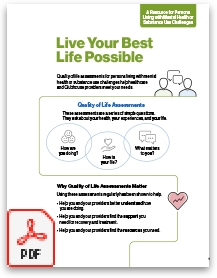
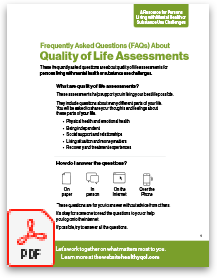
The “Live Your Best Life Possible (opens in new tab)” and the “Frequently Asked Questions (FAQs) About Quality of Life Assessments (opens in new tab)” brochures are for persons living with mental health or substance use challenges.

These resources answer questions you may have about quality of life assessments such as what are they, why they matter, and how to answer.

Quality of life assessments for persons living with mental health or substance use challenges help healthcare and Clubhouse providers meet your needs.

Doing quality of life assessments can help you live your best life possible.

What to Do

  • Answer as many questions as you can.
  • Complete the assessment before you see your provider or during your appointment.
  • Talk with your provider during your appointment about your answers.
abstract illustration of healthcare and clubhouse providers

The “Start the Conversation About Quality of Life Assessments (opens in new tab)” brochure introduces QOL assessments and gives talking points for speaking with persons living with mental health or substance use challenges.

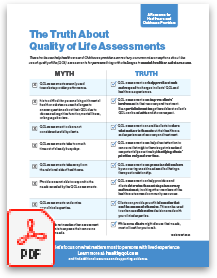
The Truth About Quality of Life Assessments (opens in new tab)” discusses the myths and facts associated with QOL assessments for persons living with mental health or substance use challenges.

Both these resources are designed to help providers incorporate QOL assessments into their practices and enhance recovery-focused, person-centred healthcare decisions. Tools such as the WHOQOL Bref (opens in new tab) help guide collaborative conversations and inform recovery plans that reflect what matters most to each individual, enabling more tailored, meaningful care.

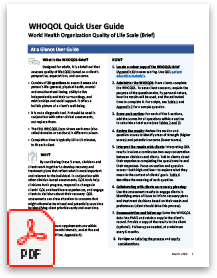
WHOQOL Quick User Guide

The guide provides a comprehensive resource about using the WHOQOL in clinical practice. For both novice and experienced users, step-by-step practical information is provided about what, why, when, and how to incorporate quality-of-life assessments for recovery-oriented care.

Although this resource is specific to a local health region, it can be adapted for other settings.


Video: Fostering Mental Well-Being: Practical Strategies for Using WHOQOL-Brief in Clinical Practice

Discover how the WHOQOL-Brief can transform community mental health services by opening meaningful conversations and guiding recovery planning. This 8-minute video offers practical tips for clinicians to confidently integrate quality-of-life assessments into routine practice, helping clients feel heard, respected, and actively involved in their care. Watch now to learn how quality of life assessment tools can make person-centered care a reality.

What to Do:

  • Incorporate the use of QOL assessments in your practice.
  • Engage persons with lived experience in QOL assessments.
  • Talk with persons with lived experience about the answers provided.
  • Use QOL assessment responses to inform recovery and treatment planning.

abstract illustration of clinical educators and practice leaders

Education and training are essential when introducing QOL assessments and for building ongoing proficiency. Continuous training supports the onboarding of healthcare providers, clinical coordinators, educators, practice leaders, managers, and directors.

Clinical educators and practice leaders can use this toolkit to

  • promote consistent use of QOL assessments
  • address common concerns and misconceptions
  • demonstrate how assessments are administered, scored, interpreted, and used in clinical decision-making
  • build provider confidence and competence

Additional educational resources support integration of QOL assessments into recovery planning. These are designed to help clinical educators and practice leaders work with clinical coordinators and providers to sustain use.


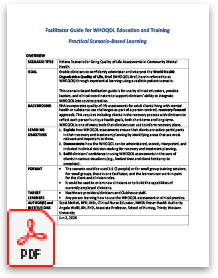
  1. The “Facilitator Guide for WHOQOL Education and Training: Practical Scenario-based Learning (opens in new tab)” uses a real-world scenario to support hands-on learning. It is designed for anyone supporting QOL use and is suitable for both new and experienced users. The scenario can be adapted for individual or group sessions, with sample timelines for 20, 60, and 120-minute formats.

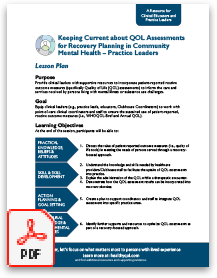
  2. The Learning exchange for community mental health practice leaders includes a lesson plan for a 6-hour event and PowerPoint.

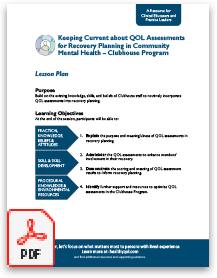
  3. The Learning exchange for Clubhouse staff includes a lesson plan for a 3‑to‑4‑hour event and PowerPoint.

What to Do:

  • Review client and provider resources with your teams.
  • Use the video and WHOQOL Quick User Guide to demonstrate QOL use in practice.
  • Offer ongoing, scenario-based training tailored to learner needs.
  • Host brief, regular team huddles to support consistent use and proactively address concerns and workflow challenges.

abstract illustration of healthcare managers and leaders

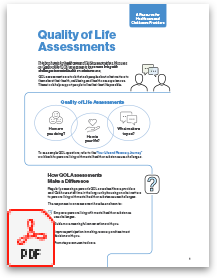
The “Making a Difference With Quality of Life Assessments (opens in new tab)” fact sheet outlines how QOL assessments support individuals living with mental health or substance use challenges. It highlights use at both the point-of-care and population level to demonstrate accountability, set priorities, and guide quality improvement.

Start the Conversation About Quality of Life Assessments (opens in new tab)” brochure provides key talking points to engage healthcare managers and executive leaders in adopting QOL assessments within a recovery-focused, person-centred approach.

Supporting Recovery Through Quality of Life Conversations with Your Team (opens in new tab)” brochure helps managers and leaders facilitate team discussions. It addresses common concerns, such as time constraints and workflow challenges, which can become barriers to routine use if left unresolved.

Together, these resources help healthcare managers and leaders in integrating QOL assessments into their organisations and informing person-centred healthcare decisions.

What to Do:

  • Initiate regular, meaningful discussions in supervisory meetings with practice leaders, clinical coordinators, and educators.
  • Engage teams in conversations about concerns, resources, and supports for consistent QOL assessment use.
  • Access QOL assessment data reports.
  • Use QOL data to inform care decisions and guide program planning.
  • Start conversations with other healthcare managers and executive leaders.


Team Overview (opens in new tab)

Co-developed in partnership with researchers, clients, and practice partners, this toolkit is grounded in a systematic review identifying key barriers and facilitators to QOL use in practice.

The protocol for the systematic review about the barriers and facilitators is found here (opens in new tab).


When using these open-source resources, please cite:

Wolff, A.C. & Research Team (2026). Quality of life assessment toolkit: [insert name of specific resource]. Trinity Western University, British Columbia, Canada. https://www.healthyqol.com

For permission to adapt or modify, contact angela.wolff@twu.ca


Supporting Publications on the Use of PROMs in Mental Health Services (opens in new tab)


Presentations, Webinars and Workshops

  •  Wolff, A., McNeil, S., Jones, B., Musto, L., Fugah, P., Sawatzky, R., Yaghoub Zadeh, Z., & Neptune, A. (May, 2026). Co-creating Evidence-based Resources for PROMs Use in Community Mental Health and Substance Use Services: A Path towards Equitable Person-centred Care. Poster presentation, Global Conference on Person-Centred Care, Gothenburg, Sweden. Access poster (opens in new tab).

  •  Wolff, A.C. (2025, Nov). Integrating PROMs into Clinical Practice: Addressing Healthcare provider barriers with practical, evidence-informed strategies to advance a collaborative, team-based future. The PROMs International Seminar Series (60 minutes), Patient-Reported Outcomes, Value & Experience (PROVE) Center, Mass General Brigham, and Harvard Medical School, Boston, MA. See recording (opens in new tab).

  •  Wolff, A.C. & Jones, B. (2024, Nov). From research to reality: Patient partner insights and evidence-based approaches for integrating PROMs into routine clinical practice (Keynote Address 75 minutes). Alberta PROMs and EQ-5D Research and Support Unit End-user Meeting, University of Alberta, Edmonton, AB. See YouTube (opens in new tab).

  •  Wolff, A.C., Austin, E., Santana, J.J., Absolom, K., Ahmed, S. & Bartlett, S. (2023, Oct). Making PROMs Work in Practice Settings: Practical Strategies to Support their Implementation by Healthcare Providers (6 hr workshop). Annual Conference for the International Society of Quality of Life, Calgary, Alberta, Canada.

  •  Wolff, A.C., Neptune, A., Musto, L., McNeil, S, Fugah, P., Sawatzky, R., Yaghoub Zadeh, Y., Neptune, A. (2024). A Resource Toolkit for clinical coordinators to support the sustained use of person-centered measures in recovery planning for Community Mental Health. Research, 33(Suppl 1), S30. https://doi.org/10.1007/s11136-024-03786-x (opens in new tab) (Oral presentation at the International Society for Quality of Life Research Annual Conference, Cologne, Germany).

  •  Wolff, A., Neptune, A., Musto, L., McNeil, S, Yaghoub Zadeh, Y., Jones, B., Slavutskiy, O. (2023). Developing clinical tools and hosting educational events to mobilize An evidence-based guideline for the sustained use of quality of life instruments in community mental health: A knowledge translation (KT) project. Quality of Life Research, 32(Suppl 2), S45. https://doi.org/10.1007/s11136-023-03530-x (opens in new tab) (Oral presentation at the International Society for Quality of Life Research Annual Conference, Calgary, Alberta, Canada).