
EPHM Project Information

This page provides information about the Equitable People-Centred Health Measurement (EPHM) project for participants, including: background, supportive resources, the questionnaires used, the survey schedule, and frequently asked questions.

Our goal is to develop shorter, more accurate, and tailored health measurement tools that reflect each person's unique experiences and background. To achieve this, we need detailed information about diagnoses and health information, social determinants of health, and perceived health and quality of life of diverse people.
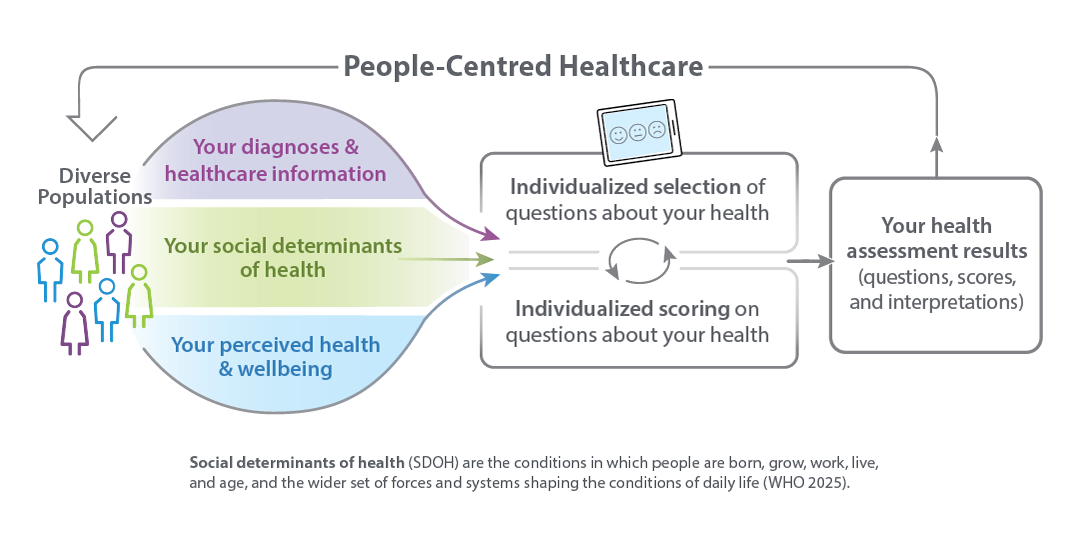
measure-model-illustration

Health surveys often use the same questions for everyone. This works well for some people but not for everyone, because people from diverse cultures, traditions, and life experiences may understand and interpret questions differently. Your participation in this project will help us to develop better surveys.

The current phase of the project builds on an online survey shared with people living in Canada in 2023. If you would like to learn more about who participated and review some results, please have a look at the following summary:

EPHM Online Survey Report (PDF - 3 pgs, 612 KB)

If you would like to revisit the study information and consent sheet, please click here

If you would like to revisit the information on how your data will be used for secondary data analyses and made available in data sharing repositories, please click here: click here

If you would like supportive resources about pain and emotional wellbeing, please click here: Mental Health and Pain Management.

Phase 1 questionnaire “Social Determinants of Health”:

SPARK

Screening for Poverty and Related social determinants to improve Knowledge of and access to resources. Screening for Poverty and Related social determinants to improve Knowledge of and access to resources.
This questionnaire was developed by the Upstream Lab. The questions ask about sociodemographic information and social needs. For more information, go to:

https://upstreamlab.org/project/spark/


Phase 1 questionnaire “Perceived Health and Wellbeing”:

WHO-QoL-BREF

World Health Organization Quality of Life – Brief.
This questionnaire was developed by the WHOQOL Group. The questions ask about quality of life. For more information, go to:

https://www.who.int/tools/whoqol/whoqol-bref/docs/default-source/publishing-policies/whoqol-bref/english_whoqol_bref


VR-12

Veterans RAND 12 (VR-12) Item Health Survey
This questionnaire was developed with the support and endorsement of the Department of Veterans Affairs and the Centers for Medicare and Medicaid Services. The questions ask about health related quality of life. For more information, go to:
https://www.bu.edu/sph/research/centers-and-groups/vr-36-vr-12-and-vr-6d/


PACIC

Patient Assessment of Chronic Illness Care.
This questionnaire was developed by Glasgow and others (2005). The questions ask about a patient’s perspective on care delivered in: patient activation, delivery system, goal setting, problem solving, and follow-up. For more information, go to:
https://eprovide.mapi-trust.org/instruments/patient-assessment-of-chronic-illness-care)


Phase 2 questionnaires: Pain (6 items) and emotional wellbeing (15 items):

PROMIS

Patient Reported Outcomes Measurement Information System (PROMIS) Short Form.
This questionnaire was developed by the National Institutes of Health (NIH). The questions ask about physical, emotional, and social health in adults and children. For more information, go to:
https://www.healthmeasures.net/explore-measurement-systems/promis

measure-model-illustration
EPHM Equitable People-Centred Health Measurement
Questionnaire A set of questions focusing on a topic such as pain, emotional wellbeing, and quality of life.
Survey A series of questionnaires linked within a survey, e.g. 4 different ques-tionnaires that approach pain from different angles
Repetitive Questions You might find some of the questions on pain and emotional wellbeing repetitive or like questions asked before. All questions are asked for different reasons and represent different points of view. There is no right or wrong answer.